About Me

I am an explorer at heart and travelling is my passion. Love to travel to remote places and discover the beauty in people and places. Particularly in love with the Himalaya...
Showing posts with label north east. Show all posts

Monday, 14 January 2019

Manipur diaries - Loktak Lake and around

Loktak Lake at Sunset - various shapes of Phumdis

Loktak lake is the first thing that comes to mind when you think Manipur, and it is indeed the Crown jewel of Manipur. It is the largest freshwater lake in North East India. If you are taking a flight to Imphal, even before reaching, you are welcomed by the unique sight of floating green rings in blue water. I was totally mesmerised by the beauty of Loktak lake - you can call it Love at first sight. And even if I were to be blamed for exaggerating, I would call it a ‘wonder of the world’.
The first sight of Loktak lake from the flight - mesmerizing


I spent around 2 days and 2 nights in Loktak. I reached Thanga village in the afternoon, just in time to see the sunset. The clouds gathered just as I was going from Moirang to Thanga, but boy … what a sunset it was… In my host’s words “the sun didn’t set” but the sunset was beautiful even with the clouds… the effects were surreal.
Loktak lake at sunset - with some clouds

Had never seen something like this earlier - floating grass...


The colours of sunset at Loktak lake, Manipur

The next day, I spent the whole day exploring Loktak lake and surroundings. I was quite enchanted with this place, it almost reminded me of Majuli - world’s largest inhabited river island. I usually wake up early to see the sunrise, but it was quite cold and foggy outside, so I chose the snug blanket instead of outdoors. Went for a long boat ride in the morning around 9 am when the fog cleared. It was a small boat which cost 500 INR for the boat, which I shared with another traveller from England. The boat is a narrow rowing boat in which you sit down on a mat and can hardly move. The ride takes around 3 hours and you float on the lake along with the floating biomass... The green coloured rings that I had seen on the lake from the flight were now all around me. The lake was stunning, with absolute silence and just occasional chirping of birds…

The serenity of Loktak Lake in the morning, the still water with reflections...

The lake is just too large, with the boat and a few floating Phumdis

A fisherman, catching fish in Loktak Lake

I learnt that the circular Phumdis are actually created by joining the pieces of floating biomass. This is actually decayed and decomposed matter of plants that aggregates together. The rings form a boundary for a fishing area. Bait is put for the fish and when enough fish come inside the circle, nets are put on the sides to prevent the fish from escaping. The inside circle of the Phumdi is cleaned of the weeds and then the fish are caught with fishing nets. Quite an interesting and elaborate system of fishing…
The biomass of a Phumdi

Fishing nets being put up on the boundary of a Phumdi - readying for catching fish

I was also told that the thickness of floating Phumdi is hardly 2 feet. And that it is possible to walk on them. Walking on the lake on a carpet of biomass... Interesting.... The boat stopped near a circular Phumdi and I got down along with the boatman. As you step on this biomass, you feel like you are riding a wave. You are not walking on firm ground any more. As you step, the water slowly steeps up. I felt I was on the moon.... The boat ride was very calming -no sounds except the gentle splash of the oar.... Saw life on Loktak from close - phumdis being made ready for fishing, fishermen and women catching fish using indigenous methods, people living on floating huts…
Walking on a Phumdi - literally on moon , walking on the lake on a carpet of grass !!


One of the methods used to catch fish was really special, which was used only by women. It involved a lot of patience, concentration and fine balancing. Difficult to explain in words, this little video will help understand the thing better.
Just watch the concentration and patience of this woman
Catching fish with just one hand...


Look at the stance of the fisher-woman - and the calf muscles....
Another favorite picture of a master craftswoman


Went to see the only floating Homestay in Loktak lake, and was offered tea by the lady of the house. Got to wear a local bamboo hat as well....
Floating homestay in Loktak lake

In the boat, wearing a bamboo hat...

Returned to the homestay for lunch. After lunch I borrowed a two wheeler from my Homestay and went to see Keibul Lamjao national park - the only floating national park in the world!! When seen from atop a view point, it appears like a land mass, as you don't see water in between, but it's just 2 feet of biomass.... And home to Sangai deer (the Manipur deer brow antlered deer), an endangered species and found only in the floating marshy grasslands of Loktak lake. This was declared extinct in 1950, but then a few years later, 6 deer were seen in Keibul Lamjao national Park and since then state government has taken measures to conserve this deer and now the total population stands at more than 60.

On the way to the national park, I crossed small villages doing mainly pisiculture (breeding fish).
Reflections... reflections..... and red coloured algae... pretty

Reflections in the clear water

You can also go to the national park directly from Moirang if you are not staying at Loktak. Or visit Loktak lake and then go to Moirang via Keibul Lamjao if you are on a day trip.The entry for the national park is INR 30 for Indians and 250 for foreigners. You are not allowed inside the national park for obvious reasons - it's all marshy land, so boats take you for a km or so. You see the sangai deer from a view point at the top using binoculars. I was lucky to spot 2 Sangai deer. Don't have a picture as I don't carry a camera with a big zoom lens.
Boats taking you in the world's only floating national park

Keibul Lamjao national park - floating land mass

This is where I spotted Sangai deer in Keibul Lamjao National Park

Notice the deer in the centre... I didn't have zoom lens..

Board at Keibul Lamjao National Park

View point at Keibul Lamjao National Park

Then I rushed back to the homestay as I wanted to get to the hilltop for the sunset panoramic view of Loktak...Mr. Maipakchao had promised that ‘the sun would definitely set today :D’  It is one of the most beautiful sunsets I have seen....
Sunset at Loktak Lake


Sunset at Loktak Lake

Sunset at Loktak Lake

Sunset at Loktak Lake

Phumdis in the warm glow of the setting sun

Sunset at Loktak Lake
Next day I spend a lazy morning, watching birds, the lake and chit chatting with other home stay guests as I was only going to Imphal and there was no hurry. I stopped at Moirang to visit the INA museum.

Moirang points of interest:
Moirang is famous for its World War and Netaji Subhash Chandra Bose related history.
INA Museum: Got a glimpse into activities of INA during the world war, but it is a very small museum, you hardly spend 30 minutes there.
Moirang market: I found the market more interesting... Had local snacks called Paakanam or the Manipuri Pizza (as was explained to me), local Pakoda and some sweet pancake made of millet probably.
Women's market in Moirang - selling pancakes, pakodas and other local street food

I savoured these Pakodas, Paakanam

India Peace Memorial: Locals call it Lokpaching or the the Japanese memorial. It is built in memory of the Japanese martyrs of the World War II by Japanese. The memorial was closed when I got down from the bus. so I jumped the wall to see it :P
This memorial has three stones - one for each of the participating armies - Japanese, British and Indian


Red Hill: again a world war related site. It is named so because the hill turned red with the blood of soldiers from both sides. Is almost a pilgrimage for Japanese tourists to India.

Reaching there and accomodation
The simplest way to go to Loktatk Lake is to hire a taxi / car from Imphal. But if you are backpacking or on a budget (that’s how I travel) - a shared Winger from the Moirang parking near Ima Market takes you to Moirang for INR 60.  From there shared autos ply to Thanga village, which is almost an island in the lake. They charge 15 rs per head and stuff 14-15 people in a large auto rickshaw, which is unbelievable, but doesn't feel all that uncomfortable when you actually ride one. There are also people hanging outside… A road in the middle of Loktak lake connects a few villages to the mainland. There's just one Homestay in Thanga village Maipakchao Homestay. Mr Maipakchao is a prominent person in the village and also heads the ecotourism committee there. If you like expensive resorts, you can also stay at the Sendra Resort.


Monday, 5 February 2018

Tripura diaries- part 2: Neermahal -The Lake Palace

Neer Mahal was my second stop in Tripura. I reached Melaghar from Kamala sagar. After Lunch and some rest, I went to the famed Neer Mahal. I wanted to hire a country boat for myself but it was not available, hence went on a motor boat on a seat basis (INR 30). The palace lived up to its reputation.  Made in the traditional Tripura style architecture, in red and white, it spreads majestically in the middle of Rudrasagar lake. Since this palace was made as a summer resort by Maharaja Bir Bikram Radhakishore Manikya, it has dancing rooms, guest rooms, a ghat for boats(yes, you read it right, one could descend into a boat from inside the palace!), garden, an amphitheatre and a hawamahal.  The palace is lit up briefly after sunset for about an hour, but the light and sound show does not happen anymore. I had read earlier blogs about boating in the lake at night to see the illuminated palace, but that is not relevant anymore. So one can even plan a day trip to Neermahal from Agartala.
I stayed at Sagar Mahal tourist lodge for two days and went to Neermahal once again in a privately hired country boat- it's an experience to remember, the silent splashing of water against the oars, the gliding boat, water snakes, floating water hyacinth creating patterns on water and the setting sun painting the sky and lake in magical colours...and the conversation with the boatman to top it all….

Reaching there:
Neermahal is around 50 km from Agartala, so one can plan a day trip from Agartala. You can hire a car or take a bus or shared jeep or Tata Magic to Melaghar. These are available from the Nagerjala bus stand in Agartala. 
Since I was travelling from Kamalasagar, I took a shared jeep (INR 20) to the T junction of road from Kamalasagar and national highway (Rastar matha in local language) and then took a bus to Melaghar. The Sagar Mahal tourist lodge is around 1.5 km from the main road. You can walk or take a shared auto / cycle rickshaw for INR 10.

Accommodation: There is a tourist lodge run by Tripura state tourism, Sagar Mahal tourist lodge, overlooking the lake. I did not see any other hotels in the market.

Tips: Neermahal is a nuisance on weekends as local educational institutes and offices come here for a picnic and their whole idea is to play cheap, irritating music loudly (and this is played in the bus while the groups are away)

Pictures of Neermahal:

Night view of Neermahal

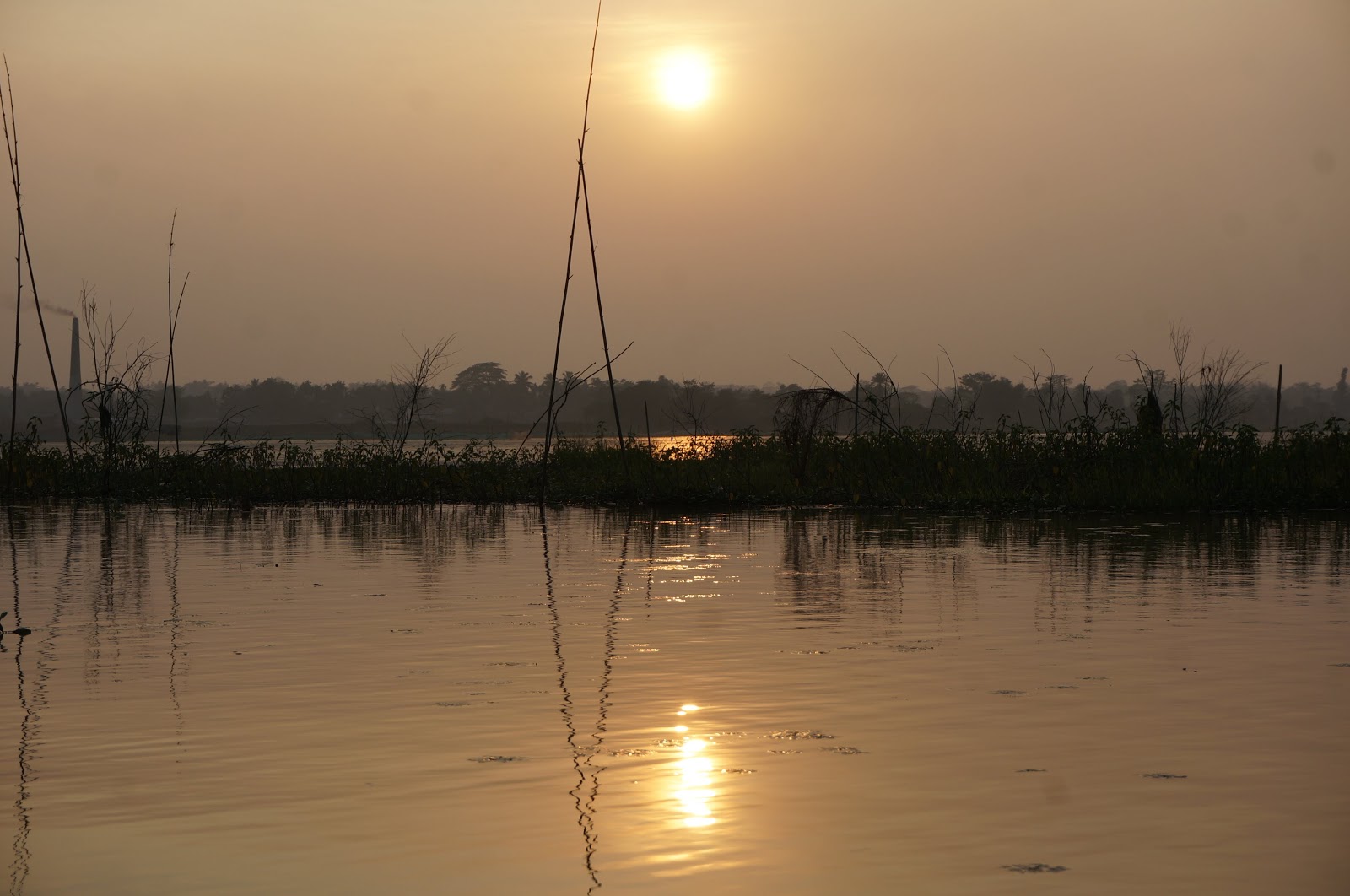
Sunset on Rudra Sagar

The boatman with Neer Mahal in the background 


Thursday, 21 December 2017

Tripura diaries- part 1- Kamalasagar - a temple and the Indo-Bangladesh Border Haat

My trip to Kamalasagar starts in a shared Tata Magic and I also pay for my bag! The road condition was very bad, even within Agartala, which later gave way to a Kachcha road. I leaned against my backpack and dozed off. There are a few villages on the way who also use the shared auto as a means of transport. You will pass by paddy fields and rubber and teak plantations as you drive towards Kamalasagar. The houses are made of unbaked clay bricks and plastered further with clay mixed with Lascha flour, which makes them water resistant.
Kamalasagar was a pleasant change from the chaos of Agartala. You can see the temple just as you alight from the bys/car/auto. There are a few shops selling pooja items and Peda for offering the goddess.


The government tourist lodge - Comilla view is located just next to the temple and you can watch the lake and Bangladesh beyond it sitting at the lodge itself or go to its terrace for a better view.

The lake next to the temple is Kamalasagar, from which the place derives its name. The Bangladesh side is called Kasba- the older name still popular for Kamalasagar as well. Even the goddess is called Kasbeshwari.

A friend had advised me to stay overnight in Kamalasagar for its night view, but thats something you can give a miss. You don't see anything additional at night. However if you like spending a day and night in solitude, then this place is for you. There is an evening Aarti in temple which is quite nice, but you can return to Agartala after it if you have a private car.

Comilla view guest House is actually in no man's land - what a feeling to be in no man's land!
The temple and the lake are on Indian land but all three sides are surrounded by Bangladesh. So as you sit looking at the lake, you can see the boundary with Bangladesh.


Another interesting thing for which people from Tripura come to this place is to see a train, yes the ubiquitous train, so commonplace in the Indian subcontinent, but plying in Tripura only since 2013. One can see the Kasba railway station of Bangladesh and trains running there.

Just look at these pictures - hard to believe that it is an international border!

And looking at these the futility of imaginary lines separating people is reinforced. And I was surprised to know that illegal immigration does not happen through this border. I even witnessed Bangladeshi nationals visiting Kamalasagar to meet their relatives and return by showing an identity card.

Kamalasagar India Bangladesh border haat:

The Border Haat is a government initiative to boost the economy of border villages of both countries. There are two in Tripura - one in Srinagar in South tripura and the other one in Kamalasagar. There is a proper concrete structure in place and every Sunday shops are set up by people of Bangladesh as well as India. These shops have special permission.

Since I had missed this unique experience during my stay here, I came back from Melaghar. And ended up travelling an extra 50 minutes as I missed the cut for Kamalasagar, and did not inform the jeep driver in advance (my overconfidence of remembering the route well - actually I dozed off 😋)

There is a long queue to obtain permission to visit the border haat. Any government issued photo id is enough to obtain permission. It took me almost an hour to get the permit.

The permission slip for which I stood in a queue for an hour

Do not carry any camera or computers, they are not allowed inside and there's no locker facility available. I requested the female BSF jawan to keep my bag at the security check post. Since I told her I am travelling alone and cannot go back all the way to Melaghar, she obliged.

The atmosphere in the haat is like a carnival.

The shops on the left are from India and the ones on right are from Bangladesh

Gorgeous Bangladeshi women shopping for Indian shawls

This is me...in the Haat

Indian shoppers thronging shops selling  readymade clothes and sarees from Bangladesh


Indian shoppers in action

The shops from Bangladesh sell clothes, biscuits, namkeen, dry fish, imported fruits whereas the Indian shops sell shawls, plastic items, cosmetics, cough syrup (yes, the ones with alcohol content). I had the best bhel from a Bangladeshi vendor, crunchy and spicy-very different from the puffed rice based bhel. It's difficult to differentiate between the shops by the look. The people are easy to identify as the population is mostly Muslim and the women from that side wear burkha. I could identify the shops based on brands- sandalina and meril soap from Bangladesh and dove, ponds , dettol, fiama etch. from India. I bought some cookies, they were quite tasty and very cheap.

Reaching there: 

Kamalasagar can be done as a day trip from Agartala. You can hire a car or take public transport which is available at a good frequency.

Public transport:

You have an option to take a state transport bus, shared jeep or Tata Magic.

There are totally three bus stands in Agartala- one to go to north Tripura, one to go to south Tripura and the third for interstate buses. The buses for Kamalasagar go from Nagerjala bus stand, but they ply from outside the bus stand, just under the bridge.  I would suggest to wait a little for the bus if you want to take public transport as the road is very bad and travelling in a jeep or Tata Magic will rattle your bones and the back.

Either of these modes takes about one and a half-hour.

You can also get transport till the T-junction of national highway and Kamalasagar road and take a shared auto from there.

Food

There are just 2-3 shops that serve a basic meal. I opted for the govt. run cafeteria for some hygiene. The food is cheap- 80 rupees for a vegetarian meal and 100 for a non vegetarian meal. 

The government cafeteria does not serve breakfast,there's just one shop selling Puri sabji at INR15, but you might carry some dry breakfast if you plan to stay. Even tea shop opens only at 8am, which was a little surprising as the eastern India wakes early, but in this place the day starts around 10am ( I visited in mid December).